Showing posts with label tour. Show all posts

22/08/2012

Factory beer?

Hard to miss!
Not by a long shot, no. Bristol Beer Factory is very un-factory-like and that is certainly a good thing. BBF has long been a favourite southern brewery of mine I was pleased to be invited along for a few beers and a snoop around by head brewer, Chris.
New 20BBL conical awaiting
comissioning.
The brewery can be found just a stone's throw from arty venue the Tobacco Factory and next door to a decent bakery in part of an old brewery closed by the George's brewery. Inside is currently a 10BBL plant, but this is being pushed to the limit, with two brews a day scheduled all the way up to Christmas. A couple of new 20BBL fermenters have arrived that take two brews to fill, the first has been commissioned and the second lies awaiting its beery cargo. This should tide them over capacity-wise until next summer when a 30BBL is due to be installed along with what seems to be a must-have for brewery expansions; a mezzanine floor! It takes a bit of tweaking and a change of yeast from top-cropping to bottom-cropping but in the end the conicals should give better yield than open fermenters.

The original open fermenters
There are also a number of conditioning tanks, some of which have followed Chris from his previous employ at York Brewery. Perhaps the most exciting section of the brewery is the barrel store. Tucked up in here are a couple of stouts for this year's "12 Stouts of Christmas" (details under tight wraps I'm afraid!) and their collaboration (with Dark Star) NZ IPA Southern Conspiracy ageing in white wine casks with gooseberries. There are some empty rum casks to be filled with an Adrian Tierney-Jones brew and some other barrels into which Melissa Cole's brew next week will be filled.

The barrel store!
Speaking of Southern Conspiracy, I popped into one of BBF's venues in Bristol, The Barley Mow, and was pleased to find this on tap. I'd neglected to check the closing time and arrived at last orders but thankfully managed to grab a pint and I'm so glad I did. I think I may have found my best beer ever, certainly if how the Ratebeer score came out is anything to go by. The influence of Mark Tranter at Dark Star certainly makes itself known, the beer reminds me a lot of Hophead. I'm very much looking forward to the white wine version then!

All that remains of current cask stocks.
There's also a new saison in the works, with a different recipe to last years successful effort. That, alongside newer beers Independence and West Coast Red sees a solid range of new beer styles alongside No.7, which is still their biggest seller at around 40% of output. Its a struggle to fit the Christmas stouts into the brewing schedule, Chris admits, but there are a few spare days at the end of next month.


Bottled beers.
Whilst there I got to try this year's home-brew competition winner Bete Noire. Its certainly different to last years winner, also a black IPA- Indian Ink. Pours transparent Brown-black like a schwarzbier with plenty of condition. Citrusy simcoe? nose with plenty of dry fruit bitterness of kiwi hops. Touch of burnt toast astringency in the finish is all that there is to remind you this is a black and not regular IPA.
A bottle of Glenlivet Imperial stout has mellowed somewhat and in my opinion is the better for it. The whisky punch has died back somewhat and the flavours have married somewhat, creating a dangerously drinkable stout, which compares favourably to the bottle of Brewdog Paradox I brought along to share.

Even @1000 bottles/hr it still takes
two people a day to bottle a fermenter's wort
There's also talk of being able to hold tastings in a new coffee shop being built as part of the bakery next-door, current tastings being held in the brewery with perhaps 2 private tours a week at the moment. Couple this with the double-brew schedule and Chris and team are set to be very busy indeed.

Chris is on Twitter: @BeerFactoryCK9 and the brewery is here: @BrisBeerFactory. If you've not yet come across BBF beers than I urge you to seek them out and keep your eyes peeled for this year's 12-Stouts of Christmas as they are bound to fly out! See Bierebelle's review here for a dfifferent perspective.

22/07/2012

A Lowland Distillery

Following on from the fun on Islay over Easter I decided to visit a completely different distillery (albeit still Diageo-owned) the East Lothian based Glenkinchie. Being Diageo I was again able to get free entry with my "Friends of Classic Malts" passport and again "Health & Safety" disallowed the taking of photographs in production areas.

There is however a fantastic exhibition with scale model of the distillery; so can do a "virtual tour". The exhibition is housed in the old maltings. Like the majority of distilleries, malt is shipped in a few times a week, where it is crushed in a mill to give a grist of 20/70/10 husk/grit/flour. The husk creates a filter bed, too high a flour proportion and you end up with a stuck mash. This is a similar principle to milling barley for beer production (which is in essence the first step of whisky production). The old grain elevator is still in place, though its now piped into the mill.

Next we see the mash tun. Mashed in at 63, with a second mash at 72 then sparged at 84, which becomes the first mashing water for the next brew. 6 wash-backs (fermenters) 4 of Oregon pine and 2 Canadian larch IIRC, chosen not for their aromatic attributes, but because their tall trunks have no branches--> no knots to form leaks. Fermentation is 60 hours, the distillery runs on a 12-hour cycle. The yeast is stored live on site and is a specific species suited for whisky distillation that gives high alcohol content and little in the way of esters that ale brewers look for.
 
Another feature from pre-H&S-conscious days is the "dramming bell" so called because when rung all workers would assemble for their measure of new-make spirit at 70%ABV.

Through into the distillation room and only two stills, though the wash still is the biggest in Scotland with a filled capacity in excess of 30,000 litres. With each fermenter taking up 20,000 litres, there's a good third of the space inside available for reflux and this contact with the copper helps to produce a lighter more grassy spirit.
The wash still is a bit smaller at ~20,000 litres but still plenty of space as a good percentage of the liquid is "pot ale" which goes to farmers as cattle feed along with the spent grain in the mash tun. In between the two distilling steps the spirit travels through the spirit safe into two receiver below. The cut for spirit is 73 to 69%, the remaining heads and tails are combined with the ext batch of low wines and redistilled.

Before the spirit safe is another, less often seen step. The whisky must be cooled from gas to liquid phase, and this is done by the means of two condensing "worms" - copper spirals in large tanks of water. The water is held on site for cooling in 3 lagoons before being discharged back into the local burn.

After distillation is the filling of the casks, done next door. There's a four storey warehouse on site but very little of the whisky is actually stored here, just the oldest stock. Most is housed in purpose built racked warehouses elsewhere in Scotland. Only ~8% of the production makes it into single malt bottles, the rest ends up in a variety of blends.


After the tour...the tasting! I've recently written about the Glenkinchie 12 y/o but there's a wide selection of single malts available for trying. If you're not driving I recommend paying the slight bit extra for a "flavour of Scotland" tour as you can choose which whiskys to sample and there's some tasty drams. I sampled the distillers edition (cask strength) finished in brandy pipes. Completely different to the regular 12 y/o with some fruity notes and much darker in colour. I prefer it.


The exhibition also has a working spirit (water) safe, which gives you a chance to play about with the cuts which is interesting, an illicit still from the distillery's past and a selection of cooperage tools. Its more interesting than the marketing displays at a lot of other distilleries and free entry if you haven't time for a tour. The shop is also well stocked with various special edition whiskys if you're looking for anything unique in Diageo's range and a number of books including a whisky and food cook book, with a few cheese and whisky pairings which caught my eye...watch this space!

02/05/2012

Lagavulin

View from the main road
Lagavulin is the second Kidalton distillery you come across, regardless of which way you travel. As member's of the classic malt society me and mine get a free tour and whisky sampling, but the tour is worth what they were asking in any case.

There's a big difference in photography rules here compared to Bruichladdich and no indoor pictures were allowed. We were ably guided around the distillery by Ruth, who gave us plenty of information on the specifics of the operation here and atsister distillery Caol Ila.

Old kiln furnaces
The majority of Lagavulin is aged on the island, here, at Port Ellen in the old distillery warehouses and up at Caol Ila and is largely sold as single malt. Conversely most of Caol Ila whisky is tankered off of theisland and destined to be used in blended whisky to addcharacter to cheaper grain whiskys.

Shiny mill.
Lagavulin is fairly modernised by Islay standards with metal mash tun and all malt now supplied by  Port Ellen maltings. We do get to see into the old kiln furnaces though.

In the wash house I experience another whisky distillery first (for me) we're given the chance to try the wash (fermented beer). Its full of smoke. quite malty and pretty thin. Not much sign of those phenolics yet, they must come through on distillation as they're certainly there in the final product! It reminded me of a rauchbier if all of the speciality malts had been stripped out.

On into the still house and the new make is positively gushing out. There's a fair amount of copper sulphate washed through. This comes from the reaction of sulphur with the copper stills and pipework, eliminating potential unpleasant offtastes from the whisky. This is a large fator in why distilleries use copper instead of stainless steel, despite the massive price difference!

We're led to the tasting room, poured a dram each then left to "supervise" the bottles as the Scandinavian occupants of the room from the preceding tour had clearly been fairly liberal with their measures!


We were able to try the regular 16 y/o expression of lagavulin plus unpeated caol ila as well as a variety of special edition releases. As a bonus, we're all given a glass to take home with us. No miniatures on sale; so no whisky for home for me this time around!

29/04/2012

Bruichladdich- the tasting!

The first-part of the distillery tour can be found here.
From the heady smells of the still-house we head back across the central courthouse to one of the many Bruichladdich warehouses. They have further warehouses in the surrounding hills and also use the old Port Charlotte dunnage warehouses for their peatier drams. Plans to reopen Port Charlotte continue apace, with stills being rescued from the defunct Innerleuven distillery to avoid the massive expense of making new ones from scratch.

This warehouse we're shown turns out to be where the magic happens, with not only the private-owned* casks stored here, but also Jim McEwan's experimental batches, with finishes in all manner of exotic casks, including rum and wine.

Into the vatting and bottling hall then, a decidedly newer area and a first for the island. The first batches were originally bottled by hand and this kit is still used for small runs, but the star of the show is the brand spanking new bottling plant. Its able to fill extraordinary numbers of bottles a day, essential for fulfilling that new Tesco contract...

 And finally, that part you've all been waiting for - how does the whisky taste? In a word...excellent. Bloody excellent in two! Well worth the wait.

We're all offered the Laddie 10, the first core expression now the whisky is old enough to be sold as a single malt. Its light, full of subtle wood character, a wisp of smoke and almost a "session" whisky in that its very easy to forget the strength and want to drink half a bottle in one sitting! We're then get offered the run of the range, with myself and other toursters doing their best to suggest a whisky they didn't have open behind the counter and willing to hand out: we don't succeed. I try the Laddie 10, Port Charlotte and Octomore in succession. They're peated at 4,40 and 152ppm respectively and boy is there a difference! The Port Charlotte is a bonfire in your mouth, all ashes and wood smoke with none of the subtleties exhibited in the Laddie. Octomore (peatiest whisky in the world!) is a different beast entirely.  Despite its OTT peat rate** it tastes nowhere near as smoky as the Port Charlotte. This whisky alone confirms that I am no longer peat-averse and more truthfully how a peat-head.

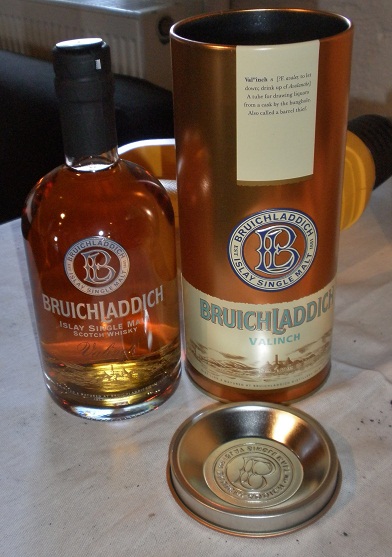
Perhaps the star of the show for me was the Valinch. "What's that?" I hear you cry! Well cry no more as I'm about to explain. A solitary cask sits mid-wall in the shop. On request you're handed an empty bottle which you then proceed to fill yourself. The cask is a one-off, only available at the brewery and never available again. The ultimate in whisky geekery. This time around its a bourbon aged Port Charlotte and at a beastly 63.5% ABV.*** Gimmicky perhaps, but still a great experience and more importantly a good tasting whisky that I'm looking forward to receiving the bottle of for my birthday (Thanks Dad!) It seems I got one of the last as they're now onto a new cask...

If you've only time to visit one whisky distillery on Islay (very poor planning on your part!) then make it this one! The enthusiasm of Helen and helpfulness of all the staff, not to mention the generous tasters all contribute to an afternoon well spent.

*Yes, it is possible to buy a cask of whisky!
** Try getting hold of one of those Brewdog!
***More details:
PORT CHARLOTTE - PREDICTION
2002 Cask No 130, Cask Type: Bourbon/La Tour
63.5%, Release Qty: 450 Bottles, Released: December 2011

28/04/2012

Bruichladdich

A distillery I was adamant I would visit as soon as my Islay trip was confirmed was bruichladdich. It simply ticked far too many boxes for me to be missed out on.
Situated in picturesque Bruichladich, it was rescued from oblivion by a consortium of bidders in 2001 and since then has gone from strength to strength. A tour for £5 a head is very reasonable indeed, given the number of samples offered and the fact it is redeemable against a bottle purchase. More on this later...
Arriving at the distillery the weary traveller is greeted by this retired still, with a jokingly placed pair of wellingtons serving as a warning to drinking on the job...
The visitor's car-park sits in the heart of the distillery and the tour begins and ends in the well-stocked shop (see for yourself!) We're led across the car-park and given a bit of the history by Helen, our knowledgable and enthusiastic tour guide. What follows is the most in-depth, open and enjoyable whisky distillery tour I've been on to date (and I've been on a fair few I can tell thee!). Kicking things off nicely we're told that nowhere is off limits* for us happy-snappers...this sits in stark contrast with many other distilleries where that handy catchall of "health and safety" is evoked for the dis-allowance of  photography (the flash can ignite spirit vapours in the air...allegedly).

The first site is the only working example of a Bobby grain mill in existence. Not only is it working but its in use, but unlike at Jura, Helen's voice rises above the din. The grist produced here is transported over the road to the mash-house. Bruichladdich produces three different ranges of whisky and we're able to taste the malt of two of these to compare how the peat changes the flavour. Although some barley is grown locally, its all malted at Inverness due to the high variety of peat specs required by the distillery. They'd love to reintroduce some floor malting but the old malting floor and kiln building is currently occupied the shop!
The mash tun is another antique of a golden age. It is made of wood, open to the elements and has a fixed rake, meaning sparging takes that bit longer. The final water is too low in sugar to be economical in a fermenter and so becomes the first liquor for the next mash. We get the obligatory peek into a fermenter  (also wood) and are hit by the overpowering CO2- this is a vigorous one then head into the still house.
The still house contains two each of wash and spirit stills plus a number of employees who soon evade the prying eyes invading their space. There's also another surprise in here (see right-hand side of pic for a hint) but that's for another post!

The stills are pretty tall and filled at quite a low level leading to a light spirit with plenty of finesse. The spirit safes are gleaming and the new-make is pouring through at a reassuring rate. This will be going into casks that won't be touched for at least ten years - a long capital tie up which made the extensive barrel stocks purchased with the distillery a must have.

Get a glimpse of these and the all important tasting in part  two of the tour tomorrow!


*Of course, the down-side of this is there's a large amount of distillery porn in this post!

22/04/2012

Jura

The approach to Islay by sea is one of anticipation as you travel up the Islay Sound to tiny Port Askaig. Next to the where the ferry docks from the main land you will find a much smaller vessel - the Jura ferry. You can sign up to become an honorary Duirach (that is citizen of Jura) which gives you a free ferry pass not to mention monthly free dram in the local hotel.

The distillery tour is also free (but needs to be booked in advance). We were lead around by shop manager Sue. The distillery is fairly noisy, and consequentially it is difficult to hear some of the information. We missed the start of the tour due to an excellent lunch in the nearby hotel.
Lovely lady and a mash tun
All of the malt comes from the Inverness maltings. The grist is mashed in a steel mash tun, this differs from distillery to distillery.
wash and spirit stills
There are two wash and two spirit stills which produce the whisky from 8 wash-backs (fermenters). The whisky is then filled into bourbon barrels. It can produce up to 2.5million litres a year. No pictures allowed in the still house (alcohol vapours apparently) but I'm allowed to take one through the open doorway.


The four regular expressions
The tour seems to be over before its started and we end up in the shop where we remain for a good while sampling various drams.  Someone seems to have a lot of money, buying the most expensive bottle in the shop (it transpires he already has one and wanted a pair).

New make
There are four expressions in the core range. The regular 10 y/o, the 16 y/o Duirach's own, the lightly peated Superstition and the heavily peated prophecy. I was lucky enough to try them side by side in the Jura hotel.

The regular expression is widely available and light gold in colour. An aroma of apricots with some sweetness and plenty of fire.

The superstition is a tad darker with some phenols at the back of the palate and a smooth finish.

Prophecy focussed too much on peat for my liking. Darkest amber and quite oily.

Diurach's Own 16 y/o
The 16 y/o was my pick of the bunch so decided to buy some to take home with me. I'll taste it now:
It pours a burnished gold with a spicy curacao orange nose with an undercurrent of iodine and brine. Initially tingly on the tongue it progresses through mushroomy cheese rind and finishes with rich heather honey with a lingering sweetness. Its a more refined version of the 10y/o and one I'll certainly enjoying every dram of.